
By Dr Magnus Lynch
MA(Cantab) DPhil(Oxon) MRCS FRCP
Consultant Dermatologist & Dermatological Surgeon
Treatment Options
Acne
|

|
Acne is a very common condition that will affect most of us at some time in our lives. It can range in severity from mild to disfiguring with significant psychological and social consequences. Acne is one of the most common conditions that I see and the good news is that there are many effective treatment options.

Topical treatments (creams, gels, lotions) are usually the first line of treatment for mild acne. They include benzoyl peroxide, topical antibiotics and topical retinoids. These treatments are often prescribed in combination.
Advantages
- Targeted to the area of concern
- Mimimally absorbed into the body so less risk of side effects
Disadvantages
- Can cause skin irritation / dryness
- Less effective than tablet treatment options and not suitable for severe acne
- Can be inconvenient and messy to apply on a daily basis

Antibiotic tablets are thought to work by reducing infection with Propionibacterium acnes although they likely have additional anti-inflammatory effects. Usually they will be taken for a course of a few months of treatment. Several different classes of antibiotic may be used. Tetracyclines, for example, lymecycline are usually well tolerated. Other antibiotics that can be used include erythromycin or trimethoprim.
Advantages
- Effective for inflammatory acne
- Well tolerated by most patients
Disadvantages
- Unlikely to be effective for severe acne
- Cannot be taken for more than a few months and acne will often recur on stopping treatments
- Some patients will experience side effects such as gastrointestinal disturbance (stomach upset)
Risks
One of the most commonly prescribed antibiotic tablets is lymecycline. Most people tolerate treatment with lymecycline without any significant side effects. You do not need to avoid alcohol. A small proportion of patients may experience side effects such as nausea, stomach upset, headaches or increased sensitivity to sunlight.
The combined oral contraceptive pill (OCP) is an option for women. It can be particularly beneficial for acne that flares prior to menstruation. Forms of the OCP, such as Yasmin, that also block male hormones (androgens) are particularly effective. The progesterone only pill 'minipill' can in some cases exacerbate acne and in this situation changing to an alternative form of contraception may be advisable. All forms of contraceptive pill require ongoing monitoring and for this reason are prescribed by your GP rather than a dermatologist.
Advantages
- Dual use - if you need a method of contraception these have the additional benefit of improving acne
- Can improve skin texture and quality through hormonal regulation
- Well tolerated by most patients
Disadvantages
- Potential for side effects
- Can take time to work and do not work for everyone
- Only suitable for women
Risks and side effects
Risks of the contraceptive pill include irregular periods, nausea, weight gain, breast tenderness, headaches, high blood pressure and blood clots.
Spironolactone is another option for women and can be particularly effective for hormonal acne. It works by blocking male hormones and reducing sebum production and is usually very well tolerated. It works whilst you are taking it but can safely be taken for years if needed. It is also widely used as a treatment for hair loss.
Advantages
- Generally well tolerated
- Very effective for hormonal acne
- Can also help other conditions such as excessive facial hair (hirsuitism) or female-pattern hair loss
Disadvantages
- Only effective whilst you are taking it
- Not suitable for men
- Requires blood monitoring
Risks and side effects
Spironolactone is generally safe and well tolerated. Common side effects include breast tenderness / enlargement, irregular menstrual periods and a drop in blood pressure (which can cause dizziness). Uncommon side effects include drowsiness, fatigue, headache, loss of libido (sex drive), confusion, rashes, abnormal blood count and high potassium levels.
Isotretinoin, also known as Roaccutane is one of the most effective treatment for acne with approximately 85-90% of patients seeing a long term improvement in the skin after completing a course of treatment, however it has a greater potential for side effects than other treatments.
Advantages
- Most effective treatment for acne
- Long-lasting improvement in skin after completing a course of treatment
- Also reduces sebum production helping greasy skin
Disadvantages
- Greater potential for side effects than other treatments
- Causes severe birth defects so a rigourous pregnancy prevention program is required
- More expensive than other treatments due to the cost of the medication and needing more follow up appointments
Risks
- Common risks of treatment include dryness of the skin, eyes and lips; nosebleeds; sun-sensitivity; muscle and joint aches; blurred vision or impaired night vision (which rarely can be permanent) and increased fats in the blood (hyperlipidamia).
- Rarer risks of treatment include inflammation of the liver (hepatitis) or pancreas (pancreatitis); raised pressure within the brain; sexual side effects (which rarely can persist after stopping treatment), inflammatory bowel disease and pyogenic granulomas (painful vascular growths most commonly around the nails).
- Acne may worsen once Isotretinoin has been started. Rarely this can lead to a severe flare of the acne resulting in scarring.
- Isotretinoin can cause mood disturbance and depression and has rarely been associated with suicide and it is essential to stop taking the medication and contact a doctor urgently if low mood arises.
- Isotretinoin causes serious birth defects and it is critical not to take the medicine if pregnant or at risk of becoming pregnant.

A number of other treatments are available including light or laser treatments. Many of these treatments can be helpful for mild or moderate acne, however they are unlikely to be effective for severe acne. More recently a newer laser treatment (Aviclear) has been developed which targets sebaceous glands in the skin this is more effective than other laser treatments but not as effective as powerful tablet medications such as isotretinoin. Dr Lynch does not offer this treatment but can refer you if needed.
Advantages
- Minimal systemic side effects: These treatments are targeted to the skin so side effects are also limited ot the skin
- Convenient with minimal downtime
- Long lasting improvement: Treatments, such as AviClear, which target the sebaceous glands in the skin have the potential to cause a long lasting improvement in acne.
Limitations
- Less effective than tablet medications such as Isotretinoin
- More expensive than tablet medications
- Variable results: Some patients will achieve good results, however others may not see a significant improvement
Frequently asked questions
Can other conditions be mistaken for acne?
The diagnosis of acne is usually straightforward and can be made by examination of the skin, however there are several other conditions that can be confused with acne:-
- Perioral dermatitis: This is a common condition that causes clusters of reddish spots on the chin, around the nostrils and sometimes around the eyes.
- Papular rosacea: This is another common condition causing redness of the face. Some forms of rosacea cause predominantly red spots on the face that can be mistaken for inflammatory acne.
- Milia: These appear as small white spots on the face - particularly on the upper cheeks. They can be mistaken for acne whiteheads. They are caused by the build up of keratin beneath the skin surface.
- Pseudofolliculitis Barbae 'Razor bumps': This condition causes inflamed spots in the beard area. It is thought to result from short hairs irritating the skin and is far more common in men, particularly those with darker skin types.
The treatment is different for these conditions and during an acne consultation, I will examine your skin to verify that the diagnosis of acne is correct and to assess whether co-existing conditions are also present.
Are there different types of acne?
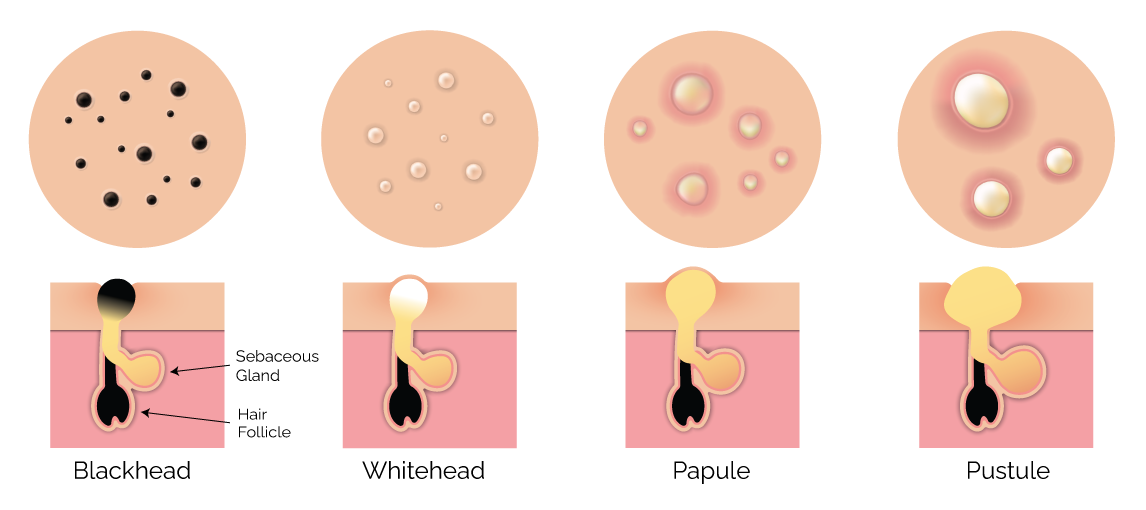
Whiteheads, also known as closed comedones, are formed when the neck of the hair follicle becomes blocked, manifesting as a whitish bump on the skin. Blackheads or open comedones are similar in nature, but the opening of the hair follicle is clogged with debris, giving it a black appearance. Inflammatory acne, the classic acne spot, presents as a red lesion and occurs when the hair follicle becomes inflamed or infected. Further inflammation or infection can lead to pustules, which are collections of white blood cells and acne nodules and cysts, which are large lumps that may persist for extended periods and have the potential to cause significant scarring.
During your consultation I will establish the types of acne lesions that you have, the degree of severity of your acne and I will look for features of hormonal acne which often affects the lower face and jaw and can vary in severity with the hormonal cycle.
What causes acne?
Acne is caused by blockage of the hair follicle. The hair follicle is a blind-ended tunnel within which the hair grows. At the top of the follicle, close to the skin surface, a gland known as a sebaceous gland secretes sebum into each hair follicle. The lining of the hair follicle is made from modified skin cells that are shed through the opening of the follicle at the skin surface.
A number of factors can trigger worsening of acne and I will ask you questions to assess whether any of the following could be relevant:-
- Hormonal factors: The production of sebum is increased by hormonal changes that occur at puberty and this is an important factor in the development of acne. Most patients with acne do not have a hormonal abnormality, however if there are other factors such as irregular periods and/or excessive hair growth the diagnosis of polycystic ovary syndrome (PCOS) should be considered.
- A change in hormonal contraception, for example stopping the combined oral contraceptive pill, changing to a new brand or starting progesterone only contraception 'minipill' can trigger a flare of acne.
- Medications: Certain medications including oral or topical steroids and some cancer treatments can trigger the development of acne so it is important to tell me about all medications that you are using.
- Thick or greasy moisturisers or make up can block the opening of the hair follicle triggering the development of acne.
- Beard oils, waxes and greasy skin and haircare products.
- Sweating: This can make acne worse, particularly on the back.
- Pressure, for example from a motorcycle helmet or from a weight bench in the gym can compress the openings of hair follicles triggering acne.
- Diet: In most cases, diet does not play a significant role in the development of acne however some studies have shown an association between a diet high in milk or high glycaemic index foods.
How should I prepare for my consultation?
In order to get the most from your consultation and ensure that all of your concerns are addressed there are a few things that you can do in advance:-
Make a list of the treatments that you have tried previously, how long you used them for and whether they were effective.
Make a list of questions that you have for me.
Take some photographs in the weeks before your appointment as the severity of acne can fluctuate.
Ideally do not wear make up to the consultation in order that I can carefully assess you skin. If you are not comfortable traveling to the appointment without make up then plan to remove at least some of the make up prior to your consutlation and re-apply afterwards.
Do some research on this website as to what treatment options are available and think about which of these might be suitable for you.
How much does acne treatment cost?
A new patient consultation costs £250. A follow up consultation costs £220. If you are having treatment with Isotretinoin you will need several appointments. If you are prescribed a medication then the pharmacy will charge you for the cost of this medication. There will be additional charges if you have blood tests privately, however your GP may be willing to arrange these for you if you prefer.
Are acne treatments different for men and women?
There are some important differences in the triggers and treatments for acne in men and women. In particular, whilst acne can be hormonally driven in both women and men, however tablet treatments which block the action of the male sex hormone (testosterone) are only suitable for females.
Which treatments are best for back acne?
Breakouts on the back often occur due to excessive sweating and can be triggered by exercise and warm weather.
There are several things that you can do to minimize breakouts on the back:
- Wash with dermol 500 rather than soap or shower gel
Use benzoyl peroxide
- Wear light cotton clothing next to the skin rather than tight compression garments
- Try to minimize pressure on the back - for example from benches in the gym
Despite these measures it can be difficult to treat acne on the back with topical products (creams/ointments/lotions) since it is hard to access and it is a large area and some patients will need tablet treatments such as oral antibiotics or isotretinoin.
Why does acne cause scarring?
Acne scarring is generally caused by moderate or severe acne, particularly where there are acne nodules or cysts. This is one of the reasons why it is important to rapidly and effectively treat moderate and severe acne - with tablet treatments if required.
Scarring reflects the body's natural response to injury. Whilst wounds in the human fetus can heal with no scar, all healing after birth is associated with at least some degree of scar formation.
As for any cause of severe inflammation, acne lesions cause damage to the epidermis and the dermis with death of keratinocytes and fibroblasts and damage to normal skin structures such as hair follicles and sweat glands. This damage is repaired by growth and division of fibroblasts - the cells responsible for production of the connective tissue in the skin. This leads to the formation of tough bands of connective tissue that characterize scar tissue and can be contrasted with the delicate fibres that make up the normal dermis.
When should acne scarring be treated?
It is essential that active acne is effectively treated before starting treatment for scarring. Treatments such as laser resurfacing and TCA CROSS carry a risk of poor healing if performed when there is active acne and new acne scars will continue to form.
After acne has been controlled scars will often improve significantly in appearance over time due to the natural remodeling of collagen that occurs with skin healing. For this reason it is usually advisable to wait for a minimum of 6 months and usually a year after completing treatment of acne before performing invasive procedures for treatment of acne scars. Another reason to delay treatment is that Isotretinoin can impair wound healing and increase the risk of poor healing.
Does retinol help acne?
Retinol is a substance structurally related to retinoids (see above). Retinol is readily available in non-prescription products and can be helpful in preventing breakouts in those with acne-prone skin.
Like retinoids, retinol causes skin cells to divide and shed reducing blockage of hair follicle openings (pores). Retinol is also thought to have numerous other benefits for the skin including improving pigmentary abnormalities and can improve the appearance of fine lines and wrinkles.
Retinol is milder than prescription-strength retinoids and can be incorporated into your daily skincare regimen. It is generally well tolerated but can cause skin irritation and dryness. If you suffer from this try a milder retinol preparation such as SkinCeuticals 0.3% retinol. Retinol can also make you more sensitive to the sunlight so it is important that you use a sun block.
What is benzoyl peroxide?
Benzoyl peroxide is a topical antiseptic that reduces the quantity of bacteria in the skin. Naturally occurring skin bacteria including P.acnes contribute to the formation of acne lesions. Benzoyl peroxide also helps to reduce blockage of hair follicles that leads to whiteheads and blackheads.
5% benzoyl peroxide is available in gel and face-wash formulations without prescription and is present at lower concentrations as an ‘active’ ingredient in a number over the counter products such as cleansers. It is additionally included with other prescription-only topical treatments such as retinoids (e.g. epiduo) or antibiotics (e.g. duac).
Benzoyl peroxide can be an effective treatment for mild acne, however it takes several weeks until you start seeing the effects. On its own It is not a suitable treatment for moderate or severe acne.
Benzoyl peroxide is a safe treatment, that is usually well tolerated, however it can irritate the skin - particularly if used in large quantities. It can also make your skin more sensitive to sunlight and can bleach clothes and hair.
Why are antibiotics used to treat acne?
Bacteria, such as Propionibacterium acnes, that are naturally present on the human skin, contribute to the formation of acne lesions (see our post on the causes of acne). Antibiotics are effective treatments for acne and are believed to work both by reducing the quantity of bacteria on the skin surface and through additional anti-inflammatory actions.
Antibiotics can be used topically (directly on the skin as creams, gels or ointments). Antibiotics used in this way include erythromycin (for example Zineryt) and clindamycin (for example duac gel or dalacin T).
Antibiotic tablets will usually be taken for a course of a few months of treatment. The most common are tetracyclines, for example, lymecycline are usually well tolerated. Other antibiotics that can be used include erythromycin or trimethoprim. Antibiotic tablets can be very effective treatments for mild or moderate acne, however acne can recur when they are discontinued.
What are combination acne treatments?
Topical acne products are often more effective when used together and this has led to the development of combination acne treatments. An advantage compared to using products individually is simplicity - rather than applying two separate products at different times, both active ingredients are applied at once.
There are multiple combination products available. Where needed Dr Lynch can also prescribe custom combination treatments for acne.
What treatments are effective for hormonal acne?
Whilst hormonal factors are relevant in both males and females, the term hormonal acne is usually reserved for acne affecting women due to sex hormones. It fluctuates according to the menstrual cycle and acne lesions often affect the chin and jawline.
The combined oral contraceptive pill (OCP) can be an effective treatment for women. Forms of the OCP, such as Yasmin, that also block male hormones (androgens) are particularly effective. All forms of contraceptive pill require ongoing monitoring and for this reason are prescribed by your general practitioner rather than a dermatologist.
Spironolactone is another option for women. It works by blocking male hormones and reducing sebum production. It is essential that you do not become pregnant whilst taking this treatment and it must be used with effective contraception. Other potential side effects include breast tenderness and high blood potassium - the latter requires blood tests for monitoring.
Why do I get dark marks after acne spots?
The development of dark marks after acne treatment can be a significant issue for patients with pigmented skin types. This is referred to as post-inflammatory hyperpigmenation.
Pigment in the skin is produced by a specialized population of cells known as melanocytes. These are situated between the thin surface layer of the skin (the epidermis) and the thicker, deeper layer that give the skin its strength (the dermis). Inflammation occurring in acne can cause melanocytes to produce additional pigment, additionally inflammation causes death of melanocytes and as a consequence they fall deeper within the skin where they are engulfed by immune cells.
Whilst these dark marks will fade with time, they can persist for many months after acne lesion have resolved and for some patients can be a greater concern than the acne lesions themselves. Assiduous photoprotection is critical; skin products including hydroquinone and retinoids and cosmeceuticals may give some minor improvement, however the most important factor is to find an effective treatment to prevent the development of further acne.
What is the best skin care routine for acne-prone skin?
If you have a tendency to acne, it is important to use non-oily products that are labeled as non-comedogenic. It is not necessary to spend a lot of money and I like moisturisers and cleansers from Cetaphil or CeraVe ranges. I generally advise patients to choose cleansers or moisturisers without active ingredients such as benzoyl peroxide or salicyclic acid and to apply these active ingredients separately where needed.
It is always advisable to use a sun block daily to prevent skin cancer, post-inflammatory hyperpigmentation and premature skin aging. I like products from the Heliocare 360 and Anthelios XL ranges.
How can I treat acne at home?
Mild acne can often be controlled with non-prescription treatments. There is no need to overcomplicate things and I generally advise starting with a cleanser in morning and evening, daily sunscreen and benzoyl peroxide once or twice daily. If this is ineffective you can trial other non-prescription treatments including salicyclic acid, alpha hydroxy acids or retinol, however at this point is usually better to see a doctor to obtain medical-grade products which are far more effective (and often less expensive). This is particularly important when you have severe acne with scarring.
What is acne conglobata?
Acne conglobata is an uncommon but severe form of acne associated with the development of multiple nodules and cysts that are so numerous that they join beneath the skin surface giving rise to large areas of painful, tender swelling. It usually affects the face but can also affect the chest and back.
Acne conglobata can lead to severe scarring over the counter treatments and topical treatments on their own are ineffective and it will usually require a powerful oral medication such as isotretinoin prescibed by a dermatologist to get control. In some cases steroid tablets (prednisolone) may be used in conjunction with isotretinoin to reduce inflammation.
Can acne run in the family?
Acne can definitely run in the family - if your parents had acne than you are likely to get it as well particularly if both of your parents suffered from the condition. There is no one acne ‘gene’, however a study of identical twins found that approximately 81% of the tendency to developing acne is caused by genetic (inherited) factors.

About Dr Magnus Lynch
MA(Cantab) DPhil(Oxon) MRCS FRCP
I am a London-based Consultant Dermatologist and Dermatological Surgeon. I am highly experienced in skin cancer diagnosis, Mohs micrographic surgery, acne, rosacea, acne scarring and laser treatments. I studied at the Universities of Cambridge and Oxford, and completed my dermatology training and Mohs fellowship at the prestigious St John's Institute of Dermatology. I graduated from medical school in 2003 and have worked exclusively in Dermatology since 2012.
I lead a research team at King's College London investigating the molecular biology of skin cancer. In recent years I have been involved in Media Appearances, including the Channel 5 series 'Skin A&E', where I perform skin surgeries and treat various skin conditions.
My NHS practice is at Guy's Hospital. I consult with private patients at OneWelbeck (near to Bond Street station) and on Harley Street. Book A Consultation.